Sunday, December 31, 2023

Dorothy's Christmas Wish

Anna Laughlin as Dorothy Gale with a Dorothy Doll

Happy New Year from VintageBroadway.com!

In December 1902, actress Anna Laughlin was back in Chicago, playing Dorothy Gale in The Wizard of Oz. She had created the part six months earlier in the world premiere, played to sold-out houses all summer, toured the eastern United States and Canada during the fall, and the show was now back in Chicago, playing to sold-out houses for the holidays. She had just turned 19 in October.

Anticipating the show's big move to Broadway a few weeks hence, Anna Laughlin wrote a short note for the holidays, expressing her Christmas wish. You can read her handwritten letter below, or scroll down a bit further and read a transcript:

A Christmas wish written by Anna Laughlin, the original Dorothy Gale.

I don't know of anything that would please me better than to wake up on Christmas morning and find that for a gift — dear old Santa had been kind enough to give me a small place in the hearts of the American public, their admiration and appreciation. I want that which is nearer and dearer to the heart of every American actress than diamonds, seal skins etc. and that is success.

If for my Christmas presents I might have success, my health and strength, and the power to make my dear mother happy, [I] would be satisfied.

The other girls may have their diamonds and beautiful gifts. But if my wish were granted I think I would be the happier.

Anna Laughlin


Anna Laughlin's Christmas wish was printed in the January 1903 issue of Vanity Fair. She would indeed find her success. The Wizard of Oz triumphed on Broadway, and after the initial run, Anna Laughlin toured the country as Dorothy well into 1905.

She went on to star in The Land of Nod and The Top o' th' World, had a solid career in vaudeville, and eventually starred in several early motion pictures. But nothing did more to make her dream a reality than creating the part of Dorothy Gale. America fell in love with little Dorothy, and many a Dorothy got her name from the little heroine that flew from Kansas to Oz, including Fred Stone's daughter, actress and dancer Dorothy Stone, and lyricist/librettist Dorothy Fields.

Merry Christmas and Happy New Year, Miss Laughlin!


Anna Laughlin as Dorothy Gale in 1902 Chicago Production.

Copyright © 2023 David Maxine. All rights reserved.

Tuesday, October 18, 2022

Herbert Jarvis Goes to the Show!

I much enjoy when I run across a contemporary audience reaction to The Wizard of Oz. One assumes there is no bias, such as an official reviewer or critic might have. Alas, most mentions of the show, like the one below, are usually lacking in detail.
 
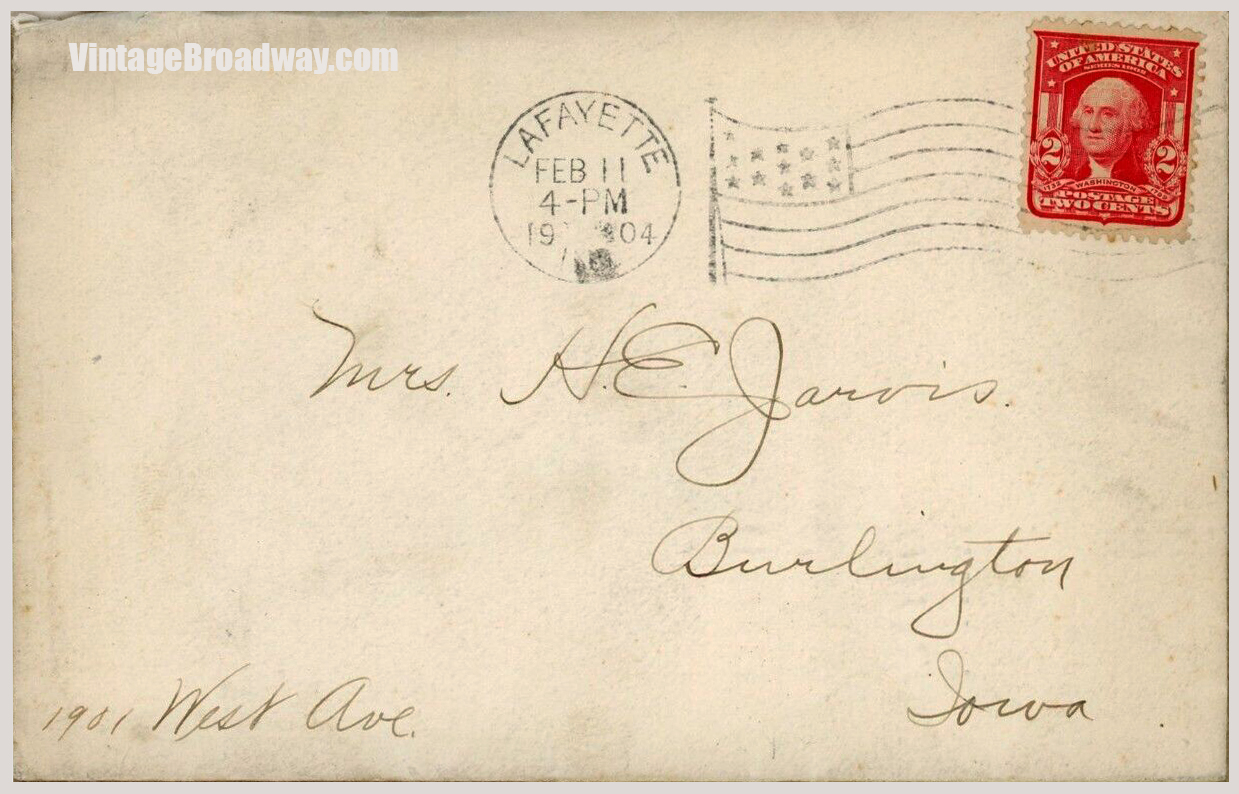
Today's blog is a brief look back in time via a letter I recently acquired, in which a young man named Herbert Jarvis wrote to his mother in Burlington, Iowa, on February 11, 1904, from Lafayette, Indiana:

Click to Enlarge

Dear Mother — 
    Did you think I'd forgotten all about you? Well I haven't by a good deal.
    Of course Fred saw you at the beginning of the week, so you knew that I spent Saturday and Sunday with him. They were having sales of clothes and so I got a very good pair of trousers for $3.50. I also got myself a pair of shoes.


Click to Enlarge

We were out at the fairgrounds Sunday - Lute Liebrick and George Lilley were with us. Lute and I took pictures. Saturday night I saw the "Wizard of Oz." It was fine and I enjoyed it more than anything else I've seen, I believe.

    Tuesday night F. Hopkinson Smith lectures on "Old Plantation Days."I think it was the best in the course so far. I took Martha Smith.
    Had I told you that the young men of the Presbyterian church were going to give a Valentine social Friday night? I was chairman of the committee that had charge of it. We've had to give it up because Mrs. Horn's father died and the funeral is to be at the church Friday afternoon. Mrs. Horn is the teacher of our young men's class at S. S.


Click to Enlarge

We are having beautiful weather. All the snow is gone and during the day it warms up just a little. The sun is bright and when the wind don't blow it feels almost like Spring.

    Lately I've been awfully hungry by dinner time. Maybe I'll eat a breakfast some of these days.

With lots of love from 

Herbert


Herbert certainly seems like a good son, and I'm glad he so enjoyed The Wizard of Oz, but we can learn a bit more by analyzing his letter home in a little more detail.

Herbert states that he attended the show on the previous Saturday, which is February 6, 1904. On that date, both touring companies were performing in Missouri. Company No. 1 was at the Century Theatre in St. Louis, their last night of a week-long engagement. Company No. 2 was doing a one-night stand in Sedalia in central Missouri.

Herbert saw the show in St. Louis with the original Broadway cast. How do we know this? Well, aside from St. Louis being closer to Indiana, where Herbert was living, he gave us a major clue elsewhere in the letter when he states: "We were out at the fairgrounds Sunday." So, the day after seeing The Wizard of Oz, Herbert and his friends went out to watch the set-up of the Louisiana Purchase Exposition, aka the St. Louis World's Fair, much like Judy Garland's character did in Meet Me in St. Louis (1944) when she boarded the trolley to go check out the progress at the fairgrounds.


Long-time Oz fans take note that when Judy sits down between two young women .57 seconds into this video clip, the woman in pink (on Judy's left) is Dorothy Tuttle, later Dorothy Nitch, who was a long-time member of the International Wizard of Oz Club, married to Oz fan Jim Nitch. Dorothy Tuttle was an MGM dancer who appeared in many films, including The Harvey Girls and The Pirate. Judy sings about half the "Trolley Song" directly to Dorothy Tuttle. Keep your eyes on the woman in pink, if you can take them off Judy Garland.

Below, you can read a review of company No. 1's run in St. Louis. It was printed in the St. Louis Republic on February 1, 1904. 


The reviewer concludes: "The music, by Paul Tietjens of St. Louis. is a satisfying feature. There isn't a tiresome song in the piece."

I'm sure Herbert Jarvis could never have imagined his letter home would be shared and dissected a hundred and twenty-two years after he wrote it. But he went to the show and went to the fair, and little else need be said. At least he also had new shoes and trousers for the occasion.

Now, if I had only had time to try and link him genealogically to Royal Historian of Oz, Eloise Jarvis McGraw, this blog would have been a little longer.


Copyright © 2022 David Maxine. All rights reserved.

Wednesday, September 14, 2022

Don't Have a Cow!

I am delighted to report that in the latest issue of the Thurston County Historical Journal, I have an article published, entitled "Luther J. Wyckoff: The Frolicsome Heifer of Oz."

Wyckoff joined The Wizard of Oz company in fall 1902 for the post-Chicago tour, where he played one of the Wizard's wisemen, among other chorus parts. In the summer of 1903, he took over the role of Imogene, after both Ed Stone and Joseph Schrode were left exhausted from playing Dorothy's devoted little bovine.

Wyckoff went on to play Imogene for almost two years with company two.

You can read all about the "frolicsome heifer" in the online version of the journal by clicking here.

My article came about after my husband, Eric Shanower, ran across an article by Mary Paynton Schaff in an earlier issue of the Thurston County Historical Journal, relating the story of Luther J. Wyckoff's later career as a hybridizer of lavender. You can read that article by clicking here.

I used the photograph below in my article on Wyckoff. It is my favorite of the various backstage photos I have. I acquired it in the late '90s when I bought three bound volumes of the New York Tribune from 1903—this photo appeared in the September 20, 1903, issue.

Luther Wyckoff (left) and Arthur Hill (right) take a break backstage at the Majestic Theatre, NYC, summer 1903.

I immediately loved the photo. It shows such an intimate moment backstage: the two sweaty young men having peeled down their animal costumes, the look Arthur Hill is giving to Wyckoff as he wipes the perspiration from his neck, and it's a good shot of the Imogene head.

Curiously, it was only after I started writing the article that I realized that it was Luther Wyckoff in the photo. I had always assumed it was Joseph Schrode (the second Imogene)—though it looks nothing like him. It looks even less like Ed Stone (the first Imogene), who was short with a very round face. But after discovering the Wyckoff lavender article and seeing multiple photos of Wyckoff, I quickly realized that it was he in the heifer's costume above.

I was also able to identify another photo of Wyckoff from earlier in the Broadway run, when he was credited as playing a Munchkin Youth (he would have also played other male chorus parts). I did not use the photo in my article, as I thought it would reproduce too poorly.

Luther J. Wyckoff as a Munchkin Youth, January 1903.
I have extremely good copies of the various Byron stage photos of The Wizard of Oz. But Wyckoff, as one of the three male Munchkins, is in the back row and the camera was not focused on him. I have sharpened the close-up (above) as much as I dare. Below, you can see the full stage image.

Luther J. Wyckoff can be seen under the green arrow.

I hope you'll go read my article on Wyckoff now.  If you like, you may order a physical copy of the journal. See the instructions in the forematter of the viewable PDF.


Copyright © 2022 David Maxine. All rights reserved.

Friday, August 19, 2022

A Simple Little Girl from the Prairie


A few weeks ago, I picked up another piano roll from The Wizard of Oz. The roll was produced by the Q-R-S Company and features "Just a Simple Little Girl from the Prairie" composed by Paul Tietjens.

The immediate curiosity is that the title differs slightly from the published sheet music, "I'm Just a Simple Girl from the Prairie." This song, written by L. Frank Baum and Paul Tietjens for the original Chicago production of the show, is not listed in programs as having been performed. But that is because the song forms part of the seven-and-a-half-minute long finale of Act II.

Julian Mitchell cut the Baum/Tietjens Chicago finale of Act II for the Broadway opening, replacing it with a new Act II finale by A. Baldwin Sloane and Glen MacDonough called "Star of My Native Land." 

Tietjens was not pleased - and Julian Mitchell may not have been wholly pleased either, as by late summer of 1903, he devised a new Act II Finale by combining both the Sloane and Tietjens compositions. Thus, "Simple Girl" was reintroduced to the show, where it stayed through the final touring performances in 1909.

The Q. R. S. piano roll company was founded in 1900 by Melville Clark, who had invented the modern player piano. He was also the Clark of "Storey & Clark," fine piano makers. Q. R. S. released a number of titles from The Wizard of Oz in addition to this one, including "When You Love, Love, Love," "I'll Be Your Honey in the Springtime," "Sammy," and, of course, the "Selection," a medley of songs and music from Tietjens's score. 

The list price for this piano roll back in 1903 was $1.20 (the equivalent of over $40.00 in today's currency). The player piano to play it on would have cost $250 (over $8000.00 in 2022).  "Just a Simple Little Girl from the Prairie" was the least expensive of Q. R. S.'s five rolls from The Wizard of Oz. The selection would have cost you $3.00 (nearly $100.00 in 2022 funds).

I have not had a chance to listen to this new roll yet. This is a "65-note" piano roll, thus it will not play on most modern player pianos. Once I have been able to play it, I will share a recording here on the blog.

If you have any piano rolls from the early Wizard of Oz stage musical, I would love to hear from you in the comments or by email.

Copyright © 2022 David Maxine. All rights reserved.

Monday, July 25, 2022

I'm All Eyes!

One thing that had been hampering the completion of my book was a much-needed research trip to New York City. My husband Eric and I had been hoping to travel east a couple years ago, after I had finally gotten down to the actual writing of text. Then Covid hit, libraries shut down, travel became unsafe, and my access to much critical research was cut off.

This past March, Covid infections hit a low point and the research facilities I needed to visit had all reopened. Eric and I were anxious for a road trip (any trip!) after two years of world lock-down. Eric said, "Let's go!" And after purchasing a new car, we took off on a three-week, cross-country road trip from Portland, Oregon, to New York City and back.

Eric and I spent many hours each day examining photos, scrapbooks, correspondence, legal documents, clippings, costume sketches, scripts, sheet music, posters, and more. 

The alarming image below shows how I felt for much of the week. It seems that I, too, "enjoy a little trip to town now and then," just like Mr. Pyeye ogling the Snow Queen and her Sprites.

Clipping from The Standard, May 27, 1904.

Much of our time was spent at the New York Public Library, but we also had a wonderful day at the Shubert Archive and visited two private collections. 

In the evenings, with libraries closed, we got the chance to visit several friends, saw the new production of Company (which I really liked), and spent our last free afternoon walking through Central Park, going to the zoo, and afterward walking across town to see Wizard of Oz producer Fred Hamlin's home at 305 West 71st Street, which he bought with profits from the show in August 1903. 

Home of Wizard of Oz producer Fred R. Hamlin.

Then we decided that as long as we were already on the east coast, we would add a few days to the trip and drive down to Washington, DC, and spend a couple days at the Library of Congress.

The research vacation was great! I got virtually everything I needed and more. Much more. Thanks to smart phones, the days of traveling with camera and macro lens and standing over a photocopier for days on end are pretty much behind us. Over the course of a week, I took slightly over seven thousand photos.

So, seven thousand new pictures . . . a picture is worth a thousand words . . . so that means seven million more words to write! Don't worry, my book isn't going to be that long!

Copyright © 2022 David Maxine. All rights reserved.

Monday, July 11, 2022

Lavender Blue, Dilly, Dilly


I am most sorry for the long time between blog posts, but much exciting work has been going on behind the scenes regarding my 1903 Wizard of Oz book project. I'll share more about that next post. 

But in the spring and early summer, my energies are also split between work on the book and work in the garden. Lately, the 1903 Wizard of Oz has found its way into the garden, too.

You might recall a blog post from early February about Luther Wyckoff, who played Imogene, the frolicsome heifer, on Broadway for a few weeks and then for two full seasons with Company No. 2. Wyckoff had begun his association with the show as a member of the male chorus in the summer of 1902 before putting on hooves as Imogene.

Now, as mentioned in the earlier post, Wyckoff abandoned the stage after his two-plus years as Imogene and in the ensuing years began in-depth research into growing lavender in the Pacific Northwest. He went on to develop his own two cultivars, "Wyckoff White" and "Wyckoff Blue," which were selected and are still used by Yardley of London—makers of the famous soap.

Upon learning all this, my husband Eric asked the inevitable question, "Are you gonna start growing Wyckoff lavender in the garden?" Of course, the answer was "Yes."

I began my search and had little luck finding it available for order online. But I placed a request at my local nursery and a couple weeks ago my "Wyckoff Lavender" arrived.

The plants are not particularly large, but they'll get bigger. So, there is now "Oz Collection" growing in the backyard. What will I do with the lavender, you ask? Well, some might go into cooking, but perhaps I should create some 1903 Wizard of Oz collectibles . . . anyone want a small Imogene the Cow sachet stuffed with "Wyckoff" lavender blossoms?

Copyright © 2022 David Maxine. All rights reserved.

Saturday, February 26, 2022

The Black WIZARD OF OZ - Part Three

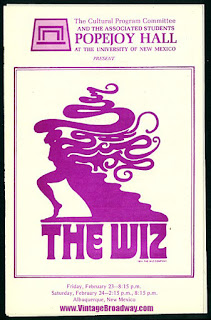
Playbill from 1979 bus-and-truck
For this final part in our Black History Month series, The BLACK Wizard of Oz, I want to share the story of how the ultimate all-Black version of Baum's story informed my career, first as a stage manager, then as a designer, and now as a theatre historian. You can read Part One and Part Two by clicking these links.

One of the most influential events in my life was seeing the national bus-and-truck tour of the original Broadway production of The Wiz on February 24, 1979.

I had just seen the film version starring Diana Ross and Michael Jackson a month and a half earlier when it had opened in December 1978. I had liked the film version well enough and was playing the double-LP soundtrack album a lot at home. After seeing the film, I started playing the original Broadway cast album a lot, too. And I was now eager to see the stage version, which was coming to Popejoy Hall on the University of New Mexico campus, where all the big touring shows and concerts played.

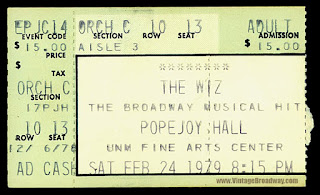
I bought two tickets to the show. I was going to the matinee by myself, and my mom, sister, and I were going to see the evening performance that night. 

Ticket stub from The Wiz on tour, 1979.

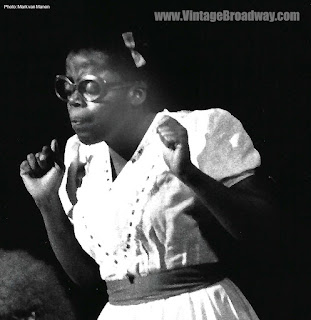
The playbill said Dorothy was to be played by someone named Deborah Malone. But there was a photocopied insert in the program saying that the role of Dorothy was NOW being played by Lillias D. White, and let me tell you, Lillias White gave and sang a performance for the ages! For those that might not know, Lillias White has gone on to become a legend and Tony Award winning Broadway star. You can read a bit about her here.

Garry Q. Lewis, Jai Oscar St. John, and Lillias White in the1979 bus-and-truck tour of The Wiz 

Lillias White as Dorothy in The Wiz circa 1979.
This was the first Broadway tour I'd ever seen, and the magic and intensity of the performance were incredible. The brilliance of Geoffrey Holder's making the Tornado a human dancer, the faithfulness to Baum's story, the fact that Dorothy was such a believable little girl . . . well, it all utterly blew me away! Lillias White, as Dorothy, also bore a startling resemblance to my best friend growing up.

I loved the second performance just as much. I had really never felt "magic" happen on stage before. I don't mean tricks, smoke, and flying monkeys; I mean that the stage disappeared, and I was totally absorbed into the show—like when reading a good book when the words disappear and you're just living the story. It was such an overwhelming experience that I knew I had to be a part of making theatre and to try to make that kind of "magic" happen for other people.

Several years later I began my theatre work as a Production Assistant at the Guthrie Theatre in Minneapolis. In 1984 I was working on Hang On To Me, a musical that was being choreographed by a lovely woman named Carmen De Lavallade (she was also acting in the show). On opening night, I discovered that Carmen was married to Geoffrey Holder, and that HE was coming to the opening night performance!

Geoffrey Holder was the director, costume designer, and artistic conscience of the original production of The Wiz. He was also an actor, had recently played Punjab in the film version of Annie, and was well known for his 7-Up commercials as the "un-cola" man. I mentioned to Carmen that I wanted to meet him, and she said, "Of course!"

I'd had only a little warning. I called home and asked my mom to bring my 
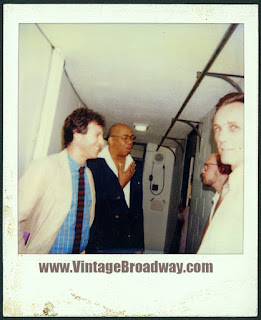
Wiz LP over to the theatre, which she kindly did. I also borrowed the Polaroid camera from the stage management office and snapped one photo of him.

Geoffrey Holder backstage at Guthrie Theatre, 1984.

Carmen introduced us, but they were on their way out to a party. There was only time for a quick hello. I told him The Wiz tour had been what made me go into theatre work. Then Geoffrey Holder signed my Wiz album. I wished we'd had a chance for a longer conversation—but for that I would have to wait several years.

Original cast album signed by Geoffrey Holder.

In the summer of 1990, my boyfriend Eric and I had just moved in together in New Haven, Connecticut. I would be starting grad school, as a scenic designer, at the Yale School of Drama in the fall. But the two of us had agreed to serve as chairmen of the 1991 Winkie Con—the annual west-coast Wizard of Oz conference. Our theme was "Oz on Stage." I wanted the Saturday evening program to be a multi-media presentation on the Broadway production of The Wiz. I secured a high-quality audio tape of the stage show and shot slides of nearly 350 photographs at the New York Public Library. I already had a substantial collection of Wiz ephemera, photos, and programs in my own collection. But I also knew this was my chance and best justification for re-connecting with Geoffrey Holder.

I still had my contact sheets from the Guthrie Theatre, so I had Carmen De Lavallade's (and therefore Geoffrey's) address. I sent a letter outlining my idea for the presentation and asked Geoffrey if we could meet for an interview. A few days later I got a simple postcard in the mail from Geoffrey Holder. It had a phone number and the words, "Call me."

So I called—nervous beyond belief! Geoffrey answered the phone with his boomingly resonant voice. He explained he had no time, but would make time, to see me. About a week later I took the train from New Haven to Manhattan. I rang the bell and was buzzed in.

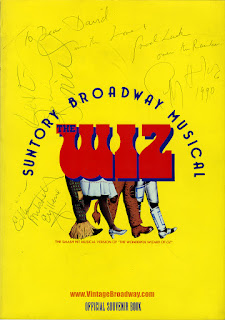
Souvenir program from Japan.
I was soon inside Geoffrey Holder's apartment, standing in front of Geoffrey Holder! He took a large breath and said, "I am most sorry, but I am going to have to cancel our interview for today. I have a meeting, I can not get out of it. Can you come back next week?" I said, "Yes, of course," but my insides were falling into my legs. Perhaps Geoffrey saw my disappointment, and before I left, he asked, "Do you have the Japanese Wiz?" I replied, No, I wasn't sure what it was. He reached up to the top of a very tall bookcase and pulled a large, yellow, over-sized book from a top shelf and added, "Then you may have this." He'd given me a copy of the beautiful deluxe souvenir program from his 1983 Wiz revival's performances in Japan. He added as he showed me to the door, "These lovely photos in the book were all taken by my son, Leo."

A week later I returned. Oddly, I was even more nervous on this second attempt to get the interview. Geoffrey welcomed me into the grand and loft-like apartment. Carmen was there this time, making coffee in the kitchen. She greeted me as an old friend and said she'd now excuse herself so Geoffrey and I could talk.

We sat down, and I opened up my backpack and pulled out my tape recorder. I also pulled out a book I had brought as a gift for Geoffrey and Carmen, a first edition of L. Frank Baum's The Enchanted Island of Yew. I had only recently learned that in 1987 Carmen had adapted and performed in a one-woman show based on this 1901 fairy tale by Baum, directed and designed by Geoffrey, with music by their son, Leo. Geoffrey called Carmen back in to see the book. They were both very pleased.

Still a nervous mess, I could barely get an intelligible question out. So, Geoffrey began by asking me why I was interested in The Wiz. I told him of my seeing the bus-and-truck tour and how important the show had been to me—though I think I rather hemmed-and-hawed out the information. 

Geoffrey was very aware of my nervousness and said he would get something to "relax me." He went to their kitchen-area and soon brought back two cups of coffee. The coffee was very black. I asked if he had any milk or cream and he explained they didn't generally keep milk in the house. But I must try the coffee—what he had put in it was much better than milk! 

I took a sip. The coffee must have been nearly half rum. Very good rum, too. It was stupendous! After a few sips, I began to relax and the interview finally began. We talked for about ninety minutes. Below are a few excerpts from our interview. I found I barely even needed to ask questions. Any few words from me brought forth wonderful and voluminous answers.

I first asked Geoffrey how he had become involved with The Wiz.

Well, number one, that was a whole accident. I met Ken Harper on the street, at Third Avenue. We had dinner. And after dinner at my apartment Harper said he want to do The Wizard of Oz with today’s music—as a television show or something to that effect. It was not a Broadway show at the time. He wanted the bad witch to be beautiful and the good witch to be ugly, someone like Moms Mabley—and Josephine Baker to be the bad witch.

He asked me, “Oh, you would be lovely as the Wiz.” Well, I said, why not? As a black guy, I said I must help him. I should support him. It was a nice idea.

Geoffrey next elaborated on how the show acquired its backers, how he developed the concept drawings and costumes.

[Ken Harper] called me and asked if I’d like to come to an audition. I wore a white suit, being very Geoffrey Holder, just to support Ken.

Now, this old man’s sitting, listening to the music, and Ken Harper only had a little cassette tape. He played the music for this man, and he tried to tell the whole story, how he had conceived the story.

This old man said, “Well, who can play Dorothy? Lena Horne is too old. We don’t have any stars.” In that period nobody ever thought of Motown—nobody ever thought of going in that direction. This old man, the only black he knew was Lena Horne!

I was very disturbed at the presentation. I said, “Ken, when I get time, I will do some drawings for you.”

So one day when I had some time, it was a Sunday, and I drew the Lion, the Tin Man and Dorothy, the Tornado, and all the characters. I called Ken—I’ll never forget this—he said, “Geoffrey, you know I don’t want to come to the west side.” I was on 92nd Street and Broadway, and he didn’t want to cross Central Park! I said, “Ken, find your ass in my house now.” So he came over and he saw the drawings and he freaked out.

I said, “The next time you have an audition, show these drawings.” These drawings would erase Judy Garland from their minds. It would erase Billie Burke. All of the images they have of The Wizard of Oz will be erased when they see it done this way.

A couple months later he got a lead to Los Angeles, to Twentieth Century Fox. I said, “Don’t leave without these drawings.” He took the drawings and I think he took Charlie Smalls, or he took his music.

He met Gordon Stalberg, head of Twentieth Century Fox. Gordon Stalberg just loved the music, just loved the drawings, didn’t care for the book—wanted him to work hard on the book. “Why doesn’t Geoffey Holder design the show, do the choreography, direct the show, and play the Wiz? And here is 750,000 dollars. Go ahead and do it.”

It was the first time a major movie company had invested in a Broadway show. It had never been done before. Ken was very happy about the whole thing.

I asked Geoffrey how he had become the director of the show. 

I had never asked to direct. I had never asked to choreograph. I didn’t ask to play the Wiz or even design the costumes. I did the costumes as a gesture to support [Ken Harper].

Well, in signing the contract, somebody said, “I don’t see how one man can do everything.” I said, “That’s an insult to my energy!” See, the major directors today have always been choreographers—Jerome Robbins, Herbert Ross, Michael Bennett. You don’t have a choreographer and a director. When you do costumes [too], you save money because you know exactly how the costumes are going to be used; you don’t have to deal with a costume designer who is busy showing his line and has not related to what the book is all about.

They had a clause that they wanted me to have a co-director. I said, “I’ve never heard of a co-director. I’m not in trouble, why would I need somebody to help me?”

And they said, “Oh, we must have a co-director.”

I said, “No no no, I need an assistant director—that’s something else.”

They said, “If you don’t sign the contract, you’re out.”

I said, “Fine, I’m out! I didn’t ask to be in in the first place. May I have back my drawings?”

They said, “Oh, we want the drawings.”

I said, “No no no, those are MY drawings.”

There was a bad conflict about that, because the concept was in the costumes. And they knew that was what Gordon Stalberg liked. I was very broken-hearted, not for the fact that I had to have a co-director. I was broken-hearted because I thought Ken Harper would have stood up for me.

Well, something told me, “Geoffrey, forget it. Resign and just do the costumes.”

“OK, I’ll do the costumes. And I want to speak to the new director”—which was Gilbert Moses, who automatically hired [choreographer] George Faison. “I don’t want him to see my costume designs. I want to know what he has in mind. These costumes were for my direction, for my choreography.”

[Gilbert Moses] said, “How can you make a wicked witch melt on stage? And how can you dwarf men and make them look like Munchkins?”

I thought he had a concept—he didn’t. The man had no vision—no fantasy vision, that is—I’m not knocking his credibility as a director. But he didn’t have a vision for the show.

The show opened and we were in Baltimore, and every time something was wrong, they criticized the costumes. They couldn’t hear the crows sing. “Cut the costumes!”

Mr. Faison wanted to have the tornado coming up like a tarantula. I said, “No, that’s baffling to the audience. A tornado is something that goes up into the sky.”

There were a lot of misunderstandings. We were doing three different shows. The reason why they really wanted Gilbert Moses was so that he could work on the book with Bill Brown. That’s what they wanted him for. When the show got in trouble, they decided to get rid of Moses. Ken Harper asked everybody—he asked Hal Prince, Donald McKayle, Patricia Birch, to direct the show. Pat Birch said, “The only person who has any sort of continuity and some vision is really Geoffrey Holder.”

I was signed to direct the show. There was a lot of bad feeling for me. I was considered arrogant. I was considered grand. And I am arrogant, and I am grand, but I know what I know, and I know what I want.

I got a hundred yards of black silk, and I went and said to the costume lady, “Make me a black bonnet. Attach this silk to the bonnet. Fly that over that trapeze and feed this girl like you feed a microphone, so that she can dance around the house as the house spins.” And that’s how we got the tornado ballet. And we stopped the show within the first two minutes! Gordon Stalberg was coming back to see the show next day, and if I’m going to be the director by then, I needed something new.

Geoffrey and I talked on for another hour at least—about adventures during the try-outs, the publicity campaign, theatre politics, Holder's 1983 revival, his short-lived involvement with the film version, Michael Jackson, and much more.

At one point, I mentioned to Geoffrey how much I loved the brilliant but subtle moment in the show when Dorothy quietly undoes her tight pigtails and lets her hair down while she is singing "Home." Dorothy visually grows-up while singing the song. 

Geoffrey seemed pleased I had noticed and remembered that specific detail from seeing the show only twice, eleven years earlier. He said that Dorothy's journey from little girl to young woman during the course of the show was critical. Dorothy had to be a little girl at the opening of the show—and how do you make a seventeen-year-old Stephanie Mills look like a little girl? He explained he had put Dorothy in her best Sunday dress, as if the family had just returned from church and Dorothy hadn't changed into her everyday clothes yet. Dorothy is running around, playing with Toto, risking wear and tear on her most expensive dress, just like any very little girl might. Then Geoffrey casually mentioned his most brilliant touch. He had designed Dorothy's dress to be just a little too small for Dorothy, a little too short. She is outgrowing it! This subtle touch shows Dorothy is a child, wearing an old dress she's becoming too big to wear and that her aunt and uncle can't easily afford to replace.

I had just graduated from NYU's undergraduate design program and would be beginning my MFA at Yale School of Drama in set and costume design in the fall. I don't think I ever got a better lesson in my life in what real costume design could be. Geoffrey had created character, informed the audience of Aunt Em's and Uncle Henry's socio-economic status, gave Stephanie Mills something to play as an actress, and with luck, triggered some strong emotion-memories in the audience—all with a little white dress that didn't fit quite right.

I remember one other thing Geoffrey said that I find most pertinent to this three-blog series about creating an all-Black version of The Wizard of Oz. Geoffrey pointed out that L. Frank Baum, in his effort to make Dorothy a universally identifiable character—an every-child, so to speak—gave no indication in the text of Dorothy's race or skin color. Even W. W. Denslow, the illustrator, had made Dorothy racially neutral by coloring her skin a non-realistic skin color, bright yellow.

Geoffrey Holder's point is essentially the same made by pioneering Black theatre critic Sylvester Russell in Part One of this series. He wrote in his 1904 article:  "The [Wizard of Oz] is a budget without race or color . . . It's a something from somewhere that nobody knows anything about." Race doesn't come into play when you're made of tin, stuffed with hay, are a lion, a cow, or a simple little girl, off on an adventure. I've little doubt that this idea informed Gertrude Blanton's decision that The Wizard of Oz was the right show for her all-Black production in 1923. 

Anyone can be Dorothy. Anyone can go to Oz. 

Advertising poster for cast album. Click to enlarge

Copyright © 1990, 2010, 2015, 2022 by David Maxine. All rights reserved.