I just ran across a splendid new performance of "The Moon Has His Eyes on You" on YouTube — a link to the video is shared below.
This song was originally performed by Sir Dashemoff Daily in Act I of The Wizard of Oz during the tour in the 1905 season. The song was also recorded by Ada Jones on both cylinder and disc during that year. Her Edison cylinder recording can be heard on my 2 CD set Vintage Recordings from the 1903 Wizard of Oz.
In the shared video, the song is performed by Robert Lamont and Gabrielle Lee. They put the song over in a slower, more sultry fashion than the fast-paced, crooning voice of Ada Jones on the recordings from the early 1900s. I suspect the original stage performance rather split the difference.
The song features music by Tin Pan Alley composer Albert Von Tilzer (1878-1956) and lyrics by African-American lyricist Billy Johnson (1858-1916). They each wrote several other songs used in The Wizard of Oz.
In December 1902, actress Anna Laughlin was back in Chicago, playing Dorothy Gale in The Wizard of Oz. She had created the part six months earlier in the world premiere, played to sold-out houses all summer, toured the eastern United States and Canada during the fall, and the show was now back in Chicago, playing to sold-out houses for the holidays. She had just turned 19 in October.
Anticipating the show's big move to Broadway a few weeks hence, Anna Laughlin wrote a short note for the holidays, expressing her Christmas wish. You can read her handwritten letter below, or scroll down a bit further and read a transcript:
A Christmas wish written by Anna Laughlin, the original Dorothy Gale.
I don't know of anything that would please me better than to wake up on Christmas morning and find that for a gift — dear old Santa had been kind enough to give me a small place in the hearts of the American public, their admiration and appreciation. I want that which is nearer and dearer to the heart of every American actress than diamonds, seal skins etc. and that is success.
If for my Christmas presents I might have success, my health and strength, and the power to make my dear mother happy, [I] would be satisfied.
The other girls may have their diamonds and beautiful gifts. But if my wish were granted I think I would be the happier.
Anna Laughlin
Anna Laughlin's Christmas wish was printed in the January 1903 issue of Vanity Fair. She would indeed find her success. The Wizard of Oz triumphed on Broadway, and after the initial run, Anna Laughlin toured the country as Dorothy well into 1905.
She went on to star in The Land of Nod and The Top o' th' World, had a solid career in vaudeville, and eventually starred in several early motion pictures. But nothing did more to make her dream a reality than creating the part of Dorothy Gale. America fell in love with little Dorothy, and many a Dorothy got her name from the little heroine that flew from Kansas to Oz, including Fred Stone's daughter, actress and dancer Dorothy Stone, and lyricist/librettist Dorothy Fields.
Merry Christmas and Happy New Year, Miss Laughlin!
Anna Laughlin as Dorothy Gale in 1902 Chicago Production.
I much enjoy when I run across a contemporary audience reaction to The Wizard of Oz. One assumes there is no bias, such as an official reviewer or critic might have. Alas, most mentions of the show, like the one below, are usually lacking in detail.
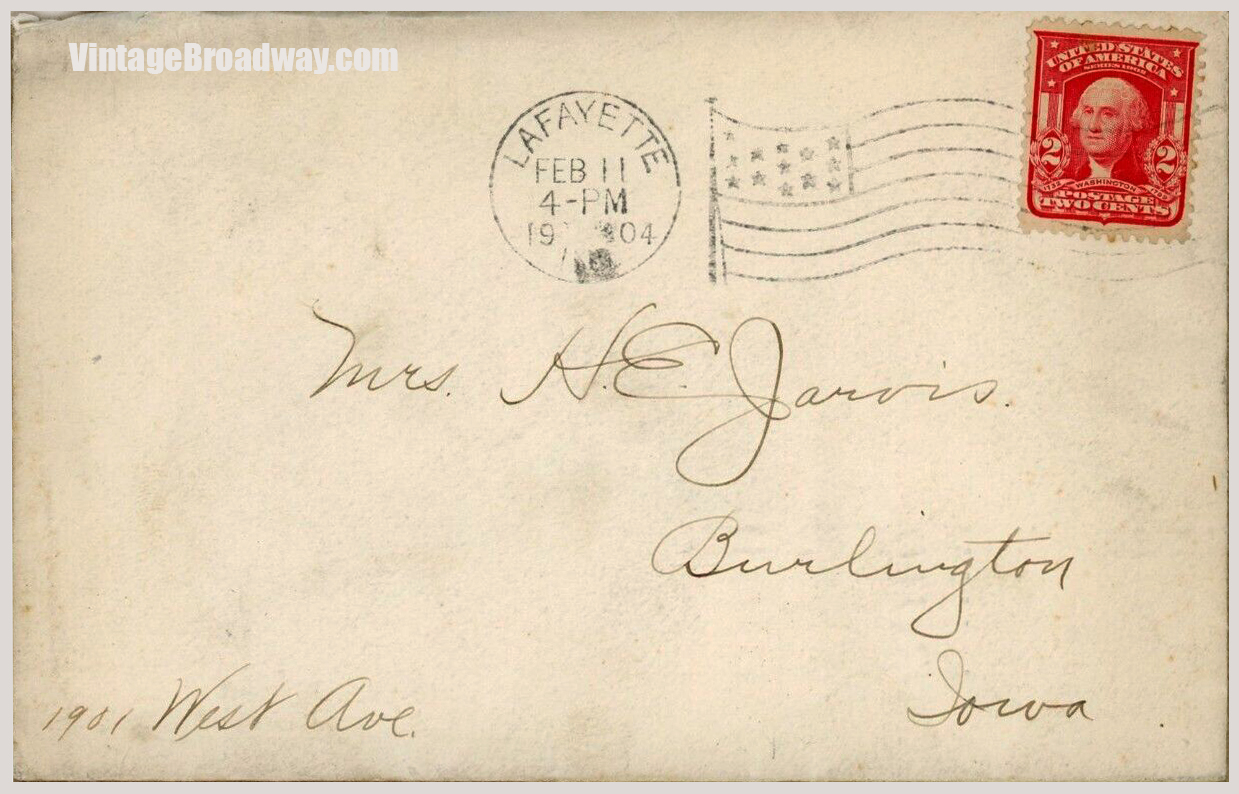
Today's blog is a brief look back in time via a letter I recently acquired, in which a young man named Herbert Jarvis wrote to his mother in Burlington, Iowa, on February 11, 1904, from Lafayette, Indiana:
Click to Enlarge
Dear Mother —
Did you think I'd forgotten all about you? Well I haven't by a good deal.
Of course Fred saw you at the beginning of the week, so you knew that I spent Saturday and Sunday with him. They were having sales of clothes and so I got a very good pair of trousers for $3.50. I also got myself a pair of shoes.
Click to Enlarge
We were out at the fairgrounds Sunday - Lute Liebrick and George Lilley were with us. Lute and I took pictures. Saturday night I saw the "Wizard of Oz." It was fine and I enjoyed it more than anything else I've seen, I believe.
Tuesday night F. Hopkinson Smith lectures on "Old Plantation Days."I think it was the best in the course so far. I took Martha Smith.
Had I told you that the young men of the Presbyterian church were going to give a Valentine social Friday night? I was chairman of the committee that had charge of it. We've had to give it up because Mrs. Horn's father died and the funeral is to be at the church Friday afternoon. Mrs. Horn is the teacher of our young men's class at S. S.
Click to Enlarge
We are having beautiful weather. All the snow is gone and during the day it warms up just a little. The sun is bright and when the wind don't blow it feels almost like Spring.
Lately I've been awfully hungry by dinner time. Maybe I'll eat a breakfast some of these days.
With lots of love from
Herbert
Herbert certainly seems like a good son, and I'm glad he so enjoyed The Wizard of Oz, but we can learn a bit more by analyzing his letter home in a little more detail.
Herbert states that he attended the show on the previous Saturday, which is February 6, 1904. On that date, both touring companies were performing in Missouri. Company No. 1 was at the Century Theatre in St. Louis, their last night of a week-long engagement. Company No. 2 was doing a one-night stand in Sedalia in central Missouri.
Herbert saw the show in St. Louis with the original Broadway cast. How do we know this? Well, aside from St. Louis being closer to Indiana, where Herbert was living, he gave us a major clue elsewhere in the letter when he states: "We were out at the fairgrounds Sunday." So, the day after seeing The Wizard of Oz, Herbert and his friends went out to watch the set-up of the Louisiana Purchase Exposition, aka the St. Louis World's Fair, much like Judy Garland's character did in Meet Me in St. Louis (1944) when she boarded the trolley to go check out the progress at the fairgrounds.
Long-time Oz fans take note that when Judy sits down between two young women .57 seconds into this video clip, the woman in pink (on Judy's left) is Dorothy Tuttle, later Dorothy Nitch, who was a long-time member of the International Wizard of Oz Club, married to Oz fan Jim Nitch. Dorothy Tuttle was an MGM dancer who appeared in many films, including The Harvey Girls and The Pirate. Judy sings about half the "Trolley Song" directly to Dorothy Tuttle. Keep your eyes on the woman in pink, if you can take them off Judy Garland.
Below, you can read a review of company No. 1's run in St. Louis. It was printed in the St. Louis Republic on February 1, 1904.
The reviewer concludes: "The music, by Paul Tietjens of St. Louis. is a satisfying feature. There isn't a tiresome song in the piece."
I'm sure Herbert Jarvis could never have imagined his letter home would be shared and dissected a hundred and twenty-two years after he wrote it. But he went to the show and went to the fair, and little else need be said. At least he also had new shoes and trousers for the occasion.
Now, if I had only had time to try and link him genealogically to Royal Historian of Oz, Eloise Jarvis McGraw, this blog would have been a little longer.
I am delighted to report that in the latest issue of the Thurston County Historical Journal, I have an article published, entitled "Luther J. Wyckoff: The Frolicsome Heifer of Oz."
Wyckoff joined The Wizard of Oz company in fall 1902 for the post-Chicago tour, where he played one of the Wizard's wisemen, among other chorus parts. In the summer of 1903, he took over the role of Imogene, after both Ed Stone and Joseph Schrode were left exhausted from playing Dorothy's devoted little bovine.
Wyckoff went on to play Imogene for almost two years with company two.
You can read all about the "frolicsome heifer" in the online version of the journal by clicking here.
My article came about after my husband, Eric Shanower, ran across an article by Mary Paynton Schaff in an earlier issue of the Thurston County Historical Journal, relating the story of Luther J. Wyckoff's later career as a hybridizer of lavender. You can read that article by clicking here.
I used the photograph below in my article on Wyckoff. It is my favorite of the various backstage photos I have. I acquired it in the late '90s when I bought three bound volumes of the New York Tribune from 1903—this photo appeared in the September 20, 1903, issue.
Luther Wyckoff (left) and Arthur Hill (right) take a break backstage at the Majestic Theatre, NYC, summer 1903.
I immediately loved the photo. It shows such an intimate moment backstage: the two sweaty young men having peeled down their animal costumes, the look Arthur Hill is giving to Wyckoff as he wipes the perspiration from his neck, and it's a good shot of the Imogene head.
Curiously, it was only after I started writing the article that I realized that it was Luther Wyckoff in the photo. I had always assumed it was Joseph Schrode (the second Imogene)—though it looks nothing like him. It looks even less like Ed Stone (the first Imogene), who was short with a very round face. But after discovering the Wyckoff lavender article and seeing multiple photos of Wyckoff, I quickly realized that it was he in the heifer's costume above.
I was also able to identify another photo of Wyckoff from earlier in the Broadway run, when he was credited as playing a Munchkin Youth (he would have also played other male chorus parts). I did not use the photo in my article, as I thought it would reproduce too poorly.
Luther J. Wyckoff as a Munchkin Youth, January 1903.
I have extremely good copies of the various Byron stage photos of The Wizard of Oz. But Wyckoff, as one of the three male Munchkins, is in the back row and the camera was not focused on him. I have sharpened the close-up (above) as much as I dare. Below, you can see the full stage image.
Luther J. Wyckoff can be seen under the green arrow.
I hope you'll go read my article on Wyckoff now. If you like, you may order a physical copy of the journal. See the instructions in the forematter of the viewable PDF.
A few weeks ago, I picked up another piano roll from The Wizard of Oz. The roll was produced by the Q-R-S Company and features "Just a Simple Little Girl from the Prairie" composed by Paul Tietjens.
The immediate curiosity is that the title differs slightly from the published sheet music, "I'm Just a Simple Girl from the Prairie." This song, written by L. Frank Baum and Paul Tietjens for the original Chicago production of the show, is not listed in programs as having been performed. But that is because the song forms part of the seven-and-a-half-minute long finale of Act II.
Julian Mitchell cut the Baum/Tietjens Chicago finale of Act II for the Broadway opening, replacing it with a new Act II finale by A. Baldwin Sloane and Glen MacDonough called "Star of My Native Land."
Tietjens was not pleased - and Julian Mitchell may not have been wholly pleased either, as by late summer of 1903, he devised a new Act II Finale by combining both the Sloane and Tietjens compositions. Thus, "Simple Girl" was reintroduced to the show, where it stayed through the final touring performances in 1909.
The Q. R. S. piano roll company was founded in 1900 by Melville Clark, who had invented the modern player piano. He was also the Clark of "Storey & Clark," fine piano makers. Q. R. S. released a number of titles from The Wizard of Oz in addition to this one, including "When You Love, Love, Love," "I'll Be Your Honey in the Springtime," "Sammy," and, of course, the "Selection," a medley of songs and music from Tietjens's score.
The list price for this piano roll back in 1903 was $1.20 (the equivalent of over $40.00 in today's currency). The player piano to play it on would have cost $250 (over $8000.00 in 2022). "Just a Simple Little Girl from the Prairie" was the least expensive of Q. R. S.'s five rolls from The Wizard of Oz. The selection would have cost you $3.00 (nearly $100.00 in 2022 funds).
I have not had a chance to listen to this new roll yet. This is a "65-note" piano roll, thus it will not play on most modern player pianos. Once I have been able to play it, I will share a recording here on the blog.
If you have any piano rolls from the early Wizard of Oz stage musical, I would love to hear from you in the comments or by email.
One thing that had been hampering the completion of my book was a much-needed research trip to New York City. My husband Eric and I had been hoping to travel east a couple years ago, after I had finally gotten down to the actual writing of text. Then Covid hit, libraries shut down, travel became unsafe, and my access to much critical research was cut off.
This past March, Covid infections hit a low point and the research facilities I needed to visit had all reopened. Eric and I were anxious for a road trip (any trip!) after two years of world lock-down. Eric said, "Let's go!" And after purchasing a new car, we took off on a three-week, cross-country road trip from Portland, Oregon, to New York City and back.
Eric and I spent many hours each day examining photos, scrapbooks, correspondence, legal documents, clippings, costume sketches, scripts, sheet music, posters, and more.
The alarming image below shows how I felt for much of the week. It seems that I, too, "enjoy a little trip to town now and then," just like Mr. Pyeye ogling the Snow Queen and her Sprites.
Clipping from The Standard, May 27, 1904.
Much of our time was spent at the New York Public Library, but we also had a wonderful day at the Shubert Archive and visited two private collections.
In the evenings, with libraries closed, we got the chance to visit several friends, saw the new production of Company (which I really liked), and spent our last free afternoon walking through Central Park, going to the zoo, and afterward walking across town to see Wizard of Oz producer Fred Hamlin's home at 305 West 71st Street, which he bought with profits from the show in August 1903.
Home of Wizard of Oz producer Fred R. Hamlin.
Then we decided that as long as we were already on the east coast, we would add a few days to the trip and drive down to Washington, DC, and spend a couple days at the Library of Congress.
The research vacation was great! I got virtually everything I needed and more. Much more. Thanks to smart phones, the days of traveling with camera and macro lens and standing over a photocopier for days on end are pretty much behind us. Over the course of a week, I took slightly over seven thousand photos.
So, seven thousand new pictures . . . a picture is worth a thousand words . . . so that means seven million more words to write! Don't worry, my book isn't going to be that long!
I am most sorry for the long time between blog posts, but much exciting work has been going on behind the scenes regarding my 1903 Wizard of Oz book project. I'll share more about that next post.
But in the spring and early summer, my energies are also split between work on the book and work in the garden. Lately, the 1903 Wizard of Oz has found its way into the garden, too.
You might recall a blog post from early February about Luther Wyckoff, who played Imogene, the frolicsome heifer, on Broadway for a few weeks and then for two full seasons with Company No. 2. Wyckoff had begun his association with the show as a member of the male chorus in the summer of 1902 before putting on hooves as Imogene.
Now, as mentioned in the earlier post, Wyckoff abandoned the stage after his two-plus years as Imogene and in the ensuing years began in-depth research into growing lavender in the Pacific Northwest. He went on to develop his own two cultivars, "Wyckoff White" and "Wyckoff Blue," which were selected and are still used by Yardley of London—makers of the famous soap.
Upon learning all this, my husband Eric asked the inevitable question, "Are you gonna start growing Wyckoff lavender in the garden?" Of course, the answer was "Yes."
I began my search and had little luck finding it available for order online. But I placed a request at my local nursery and a couple weeks ago my "Wyckoff Lavender" arrived.
The plants are not particularly large, but they'll get bigger. So, there is now "Oz Collection" growing in the backyard. What will I do with the lavender, you ask? Well, some might go into cooking, but perhaps I should create some 1903 Wizard of Oz collectibles . . . anyone want a small Imogene the Cow sachet stuffed with "Wyckoff" lavender blossoms?