Wednesday, February 23, 2022

The Black WIZARD OF OZ - Part Two

As you read in Part One of this series, Black music and theatre critic Sylvester Russell proposed a "colored company" of the Baum and Tietjens Wizard of Oz in early 1904. As wonderful as his casting ideas were, the producers never pursued the idea.

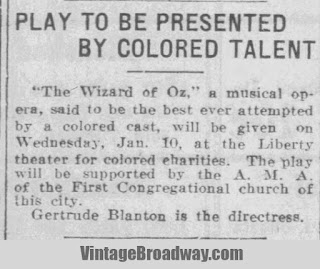
But Russell was not the only Black American to imagine such possibilities. Two days before Christmas 1922, the Chattanooga News announced:

WIZARD OF OZ 
Colored People to Give Play January 10 

The Wizard of Oz, a musical opera said to be the best ever presented by a colored cast, will be given Wednesday, January 10, at the Liberty Theater. The play will be supported by the A.M.A. [American Missionary Association] of the First Congregational church of this city, with Gertrude Blanton director. The proceeds of the play will be devoted to charities of the colored people.
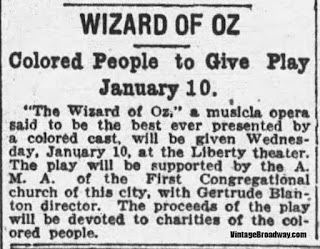
Chattanooga News, December 23, 1922

This production of The Wizard of Oz to be given by "colored people" was the brainchild of Gertrude Blanton. She was Born Gertrude Edwina Lewis, youngest daughter of Albert and Ellen Lewis, on September 9, 1888. The 1910 census reports her working as a musician in an orchestra. In 1912, Gertrude married James Harvey Blanton and they eventually had three children: Dorothy born in 1914; James, Jr., born in 1919; and later, in 1928, another daughter, Caroline. Gertrude continued her musical career as pianist, musical director, and conductor while raising her family.
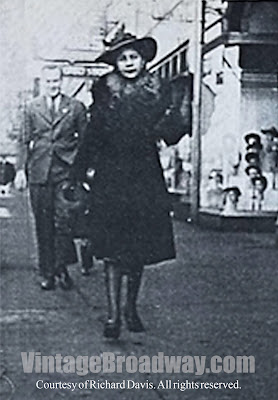
Gertrude Blanton circa 1930. Courtesy of Richard Davis.

Chattanooga Daily Times, December 24, 1922
Gertrude Blanton had directed one other stage work with students from Howard High called A Trip to Zanzibar, on May 18, 1922, about six months prior to her staging of The Wizard of Oz. 

There's no information on how or why Blanton came to the idea to stage a Black version of The Wizard of Oz. The original national tour played in Chattanooga four times between 1904 and 1908. I like to think Blanton saw the show and became fond of it. She named her first born daughter Dorothy, too. 

Tennessee's "Jim Crow" laws regarding Blacks attending theatre performances were not quite as heinous as many of Tennessee's other forms of repression. According to Blackpast.org, the 1885 Tennessee statute provided for: "All well-behaved persons to be admitted to theaters, parks, shows, or other public amusements," but the statute also declared that proprietors had "the right to create separate accommodations for whites and negroes." So, Blanton certainly had the opportunity to see The Wizard of Oz on several occasions when she was a teenager.

No definitive proof has surfaced that Blanton's 1923 production was a performance of the 1903 Baum and Tietjens musical extravaganza, but what else could it have been?

Timing discounts the possibility of it being the Junior League stage version of The Wizard of Oz, which had been written and performed for the first time on December 23, 1922, the same day Blanton's production was announced. The Junior League script had not yet been published and Blanton, not even a member of the Junior League, would not have had access to it.

Advertisements explicitly refer to Blanton's production as a musical opera and musical comedy, and there is no evidence that Blanton, or anyone else, composed a new score. If she, or anyone else, had written a new score, I think it would have been mentioned in publicity. I have also found no evidence that Blanton was a composer. 

Blanton was a professional musician, playing in orchestras and bands for at least a dozen years by this point. She would have been conscious of properly acquiring performance rights. I believe that Blanton rented the performance materials for The Wizard of Oz from Tams-Witmark, and what we have here is the first, and so far, only performance of the Baum-Tietjens Wizard of Oz performed by a Black cast.

The Wizard of Oz seems to be the last stage work that Blanton directed. But Blanton managed several small orchestras and bands—one "Colored Orchestra" called the Syncopating Six. They played at hotels, clubs, and dancehalls. The Chattanooga Daily Times reported on June 19, 1932, that "one of the largest dances of the season at Cloudland on Lookout Mountain, took place last evening at the hotel, with Gertrude Blanton and her Syncopating Six playing."

Chattanooga Daily Times, July 21, 1933
During this time, she and her husband continued to raise their family of three children. Author Matthias Heyman writes about the Blanton family:
In 1912, . . . Gertrude married another Chattanooga native, James Blanton, and the pair moved in with her parents in their red-bricked house on 320 Cherry Street, situated on the border of downtown Chattanooga, once home to affluent white middle class families, and Ninth Street (on the East Side, now Martin Luther King Boulevard), a “center of African American life in Chattanooga since the mid-1800s.”

The Blanton children grew up in relative prosperity surrounded by a warm and caring family: Dorothy remembers that her parents “always saw [to it that] we had plenty of toys. We had bicycles and wagons and scooters.” The three children playfully called themselves the "three musketeers," and all members of the family were given affectionate names: Albert and Ellen [Gertrude's parents], who continued to live in the Cherry Street house until their deaths, were called Momma and Poppa, their son-in-law, James, Sr., was known as Jim, and their daughter Gertrude as Gert, while Dorothy, Jimmie, and Caroline were referred to as Dotty, Brother, and Tines, respectively.

The central figure in the Blanton family was Gertrude. While James, Sr., helped to make all important decisions, it was she who took care of the day-to-day business of housekeeping and raising the children, as well as caring for both her resident parents. While this would take up most of her day, it still allowed for her actual profession, which was mainly limited to evenings and nights: pianist and bandleader. Indeed, Gertrude was a professional, self-employed pianist who led a first-call small band for “all the local ‘high society’ dances.” “There’s a jump unit known as Ms. Blanton and her Swingsters who walk off with most of the society gigs around the mountain city of Chattanooga,” reported Down Beat in February 1940, where it was revealed that this combo’s leader was indeed the mother of Jimmie, the “sensational [] solo bass man now starring with Duke Ellington’s band.” She may even have been somewhat of a musical entrepreneur. Wendell Marshall, her nephew and future Ellington bassist as well (he was the son of Hattie Lewis, Gertrude’s older sister), maintained she managed about three to five bands in the Chattanooga region, often simultaneously, going from one club to another to make an appearance. Furthermore, the 1940 census lists her profession as a music teacher, so she might have taken in the occasional private student on the side as well.

Through her, music was an essential part of the family: Dorothy learned to play the piano, Jimmie first took up the violin before switching to string bass . . . , and Caroline sang. Gertrude took her children everywhere, including the bandstand, and they would occasionally perform with their mother’s band(s). There can be little doubt that this early experience was of vital importance to Jimmie’s swift rise to professional musicianship.

So, why is Matthias Heyman writing about the Blanton family? Because son, Jimmie, grew up to become an incredible musician—the jazz double bassist Jimmie Blanton. You can read more about Jimmie and Heyman's forthcoming book, Jimmie Blanton. Revolutionizing the Jazz Bass: The Life and Music of Jimmie Blanton—to be published by Oxford University Press— by visiting Heyman's website: www.mattheyman.com

Jimmie Blanton exploded on the jazz scene. On November 19, 1939, Jasper T. Duncan of The Chattanooga Daily Times reported in his "Activities Among Negroes" column:

Another hometown colored boy has made good in music in the east. He is Jimmie ("Kid") Blanton, son of Gertrude Blanton, well known in music circles as an orchestra leader, and who plays for several of the most exclusive dance schools of the city. 
"Kid" Blanton, a native Chattanoogan, was taught the rudiments of violin technique by Dr. J. L. Looney, local practitioner, followed his studies through, and is now a member of the Duke Ellington band featured not as a "doubler," but as a violinist, of whom Ellington says, "there is no finer before the public today in the field of commercial music.' 
Blanton is on tour with the orchestra at the present time, and has been extolled in musical magazines throughout the country for his outstanding ability.
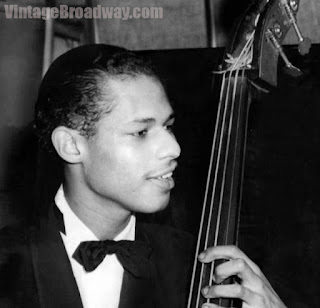
Jimmie Blanton
Jimmie Blanton joined Duke Ellington's band in 1939 and through their multiple recordings, transformed jazz and how the jazz bass could be played. While Blanton's recordings and influence live on still, his life and career were cut tragically short. In November 1941, he left Ellington's band, suffering from tuberculosis. His mother, Gertrude, was at his bedside when he died on July 30, 1942, at the age of 23.

*          *          *

In addition to her family, Gertrude Blanton touched many other lives through her music and musicianship, including all those she cast in The Wizard of Oz back in late 1922.

The morning of Blanton's production of the show, the Chattanooga Daily Times reported that The Wizard of Oz would be performed by "a cast of about sixty performers," with the principal parts taken by students of Howard High School. 
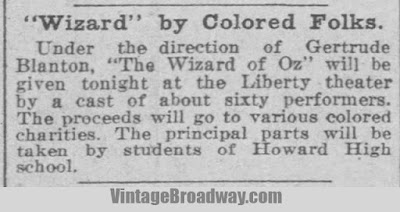
Chattanooga Daily Times, January 10, 1923

The Chattanooga Daily Times reviewed the performance on January 11, 1923:
"Wizard of Oz" Given.

A very creditable presentation of The Wizard of Oz was given last night at the Liberty theater on East Ninth street by a cast of colored amateurs. Horace Hicks was the Tin-man, and Alonzo Pope, the Scarecrow. The role of Dorothy of Kansas was well played by Dorothy Blanton. Others in the cast were Dave Smith, Minerva Hatcher and Thelma Vaughan. The musical comedy was directed by Gertrude Blanton and a good sum was raised for colored charities.
I spent some time looking into the cast. Blanton's eight-year-old daughter, Dorothy (called Dotty by her family), was cast as Dorothy Gale. The other principal parts were students at the all-Black Howard High School. 

Alonzo H. Pope, who played the Scarecrow, was a sophomore at the time. He graduated from Howard High in 1925, attended Fisk University in Nashville, Tennessee, and married Louise Marshall. They had two sons, Alonzo, Jr., and Thomas. 

Horace Hicks, who played the Tin Woodman, had a fine voice and performed with several "colored" men's choruses.

The only other cast member I could find information on was Minerva Hatcher. Alas, I do not know what character she played in Blanton's production of The Wizard of Oz. But she grew up to have a rich and influential life. Minerva Hatcher was born in Montgomery, Alabama, on September 22, 1906, and almost immediately, the Hatcher family moved to Orlando, Florida.
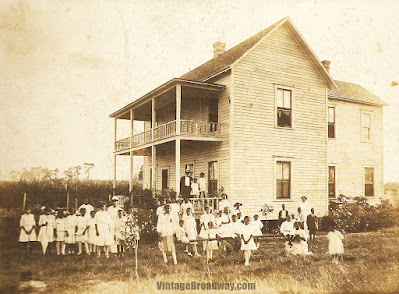
Minerva's 7th Birthday, 1913. The KKK burned the house a few days later.

Shortly after Minerva's seventh birthday, the family returned from church to discover their home had been burned down by the Ku Klux Klan. Minerva was sent to live with relatives in Chattanooga. 

Minerva Hatcher's high school graduation, 1923.

Minerva was a senior at Howard High School in 1923 when she performed in The Wizard of Oz. She graduated several months later. She went on to receive a B.A. and an M. A. from Fisk University, the third generation in her family to attend Fisk. She attended Yale University as the only Black John Hay Fellow in Humanities, under the Whitney Foundation, in 1952-'53. Of her time at Yale she said:
I spent the weekdays at Yale, but I'd spend the weekends visiting a friend of mine in Harlem. I told my classmates I could act like a white during the week, but on weekends I had to get back to being black.
Her first husband, Henderson A. Johnson, Jr., was a coach at Fisk. They had a son, Dr. H. Andrew Johnson, III, a dentist. Her husband died in 1954, and Minerva married a second time, to William Daniel Hawkins, Jr., in June 1955.

In 1946, Minerva began teaching at Pearl High School in Nashville, Tennessee. She taught American History and was the senior adviser for twenty-three years. In 1999, one of her former students, civil rights leader Mary Frances Berry, said: "There was a high school teacher, Minerva Johnson Hawkins, who expanded my vision of life, and I feel obligated to try to do the same for others."

Minerva Hatcher - Courtesy of Greg Johnson.

Minerva died May 18, 2001, in Nashville, Tennessee. She was 94. Minerva's granddaughter said: "She told stories about African-American history you don't read in textbooks."

*          *          *

Gertrude Blanton lived until January 1969 and died at the age of eighty in Detroit. Had she lived another several years she would have been able to see the most important Black production of The Wizard of Oz ever—Charlie Smalls and Geoffrey Holder's The Wiz. But, of course, Gertrude Blanton had that idea fifty-two years before they did!
___________________________________________


I extend grateful thanks to Gregory Johnson for both family stories and
permission to share photos of his grandmother, Minerva Hatcher Johnson Hawkins.

And many thanks to Matthias Heyman for information on Gertrude Blanton and her family
from his forthcoming book. You can read much more about Jimmie Blanton's life
and music on Matt Heyman's blog Pitter Panter Chatter

Photograph of Gertrude Blanton courtesy of Richard Davis. All rights reserved.

Copyright © 2022 David Maxine. All rights reserved.

Monday, February 7, 2022

The Black WIZARD OF OZ - Part One

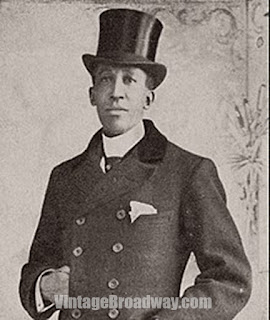
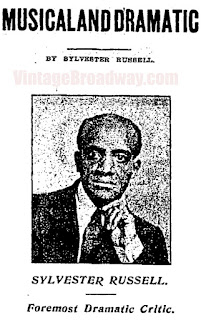
Theatre critic Sylvester Russell
Seventy-one years before the premiere of The Wiz, a Black journalist and theatre critic named Sylvester Russell first proposed a production of The Wizard of Oz with a Black cast. 

Russell began his career as a singer in the late 1880s as Harvey Russell. In 1891, resisting attempts to pigeon-hole him as just another "minstrel" performer, he wrote a letter to the editor of the New York Age, explaining he was not associated with any minstrel troupe and should "hereafter be known as the famous countertenor." Click here to read more about Sylvester Russell. By the late 1890s, Russell had transitioned from singer to music and theatre critic, writing for newspapers such as the Indianapolis Freeman and the Chicago Defender.

Russell published his critique of The Wizard of Oz in the February 27, 1904, issue of the Indianapolis Freeman, the first illustrated Black newspaper in the United States. The Wizard of Oz had recently completed a run at English's Opera House in Indianapolis, February 18-20, 1904. 

The Wizard of Oz produced a strong response in Russell, so much so that he felt compelled, for the first time, to review a white performance.

THE WIZARD OF OZ

By Sylvester Russell

For the first time in my history as a stage critic I review a white performance. I do so merely for comparison and to satisfy colored actors that my past criticisms have been quite favorable to their future comedy success.

The Wizard of Oz is a musical comedy extravaganza, exploiting Dave Montgomery and Fred P. [sic] Stone as stars. The Wizard is a very large production with the usual 75 people billed as 150. The curtain rises on a gale storm such as you have never before seen.

When the storm subsides, you behold a beautiful chorus of women and plenty of fresh painted scenery which changes to many different shades by mean of transcendent lights. All this is a portion of extravagant time which pleases the eyes and eases the playwright.

The Wizard of Oz is said to be the greatest musical comedy of the season, but it is certainly not the funniest, and that's why I review it.

The choruses work well and the incidental music is fine. The singing is made up of popular sounds and choruses, which all go well, surrounded by an atmosphere of heavenly grandeur. This means the music is by many different composers without any regard to what the programs say.

The popular song, "Sammy," is sung by a quaint soubrette dressed in a short skirt of silvery glittering spangles. She sings to a man in one of the boxes, which proves that any old gag of the variety stage order suits the majority. What a pity this young woman can't talk to the men in boxes, in the bargain, and set the houses wild—she would even be quite as legitimate as she is now.

Ada Overton Walker (1880-1914)
"Sammy" is a bird. This same song, if enacted by Ada Overton Walker would be a walkover. Another little soubrette, Miss Loughlin [sic], I believe, with a very weak voice, was quite a feature. There is only one real female singer in the show and she sings love songs very tunefully. The singing of the chorus is good, but no better than the Howard Atheneaum Stock Burlesque Company in Boston, which can boast of having one of the best drilled choruses of real voices in America.

Montgomery and Stone as Stars

Nothing is more pleasing to a manager than to read the critic's estimation of his stars, especially when they have to play characters bordering on the very verge of insanity. In the first place, Montgomery and Stone's names are twisted.

The bills should read Stone and Montgomery. If Montgomery had less name and more ability, his partner, Fred P. [sic] Stone, would not be able to attract as much attention as he does. Neither of them are loaded down with much more than nimble feet and a natural appetite for dancing. 

Fred Stone plays the principal comedy part, for no other reason than being the best comedian of the two. His first creation of a "man without brains" is an easy victory for a starter, and he has nothing to do until he is given some brains. In some parts of the dialogue Montgomery and Stone may have been botchworkers and many of the comedians of to-day are badly affected with spoiling much of the fruit of a good playwright's mind. But we can rest assured that Fred P. [sic] Stone is a good comedian and gives good account of his worthy exercises. Mr. Montgomery is simply a very good buck dancer and outside of that, verdict is dismissed. He wears a heavy clad suit of clothes that will save him from making a fatal attempt at real acting. He also sings through the limbs of a tree, not a hoodoo tree such as we used to see DeWolf Hopper display his matchless buffoonery in, in [the] comic opera Boccaccio. No. He sticks his head through a limb and bids the chorus girls to do the rest. 

Montgomery has a good, loud voice, and being a graduate from the variety stage, he knows how to use it.

I forget now where it was I remember as far back as seeing him play a dime museum engagement. Just for the sake of mediocrity of racial comparison, I might state that Montgomery and Stone, two white comedians who have worked their way up from the lowest rank of performers, did not succeed in reaching the goal in advance of Williams and Walker, who had to plough through all the common prejudices of America; even succeeding in reaching the king's throne in a country where lynching is unknown and where color has no drawbacks except from an inferior European-American. This proves that colored performers, like other successful people of their race, are fully entitled to all the honors in proportion that a King or a U. S. President can bestow upon them.

Indeed, if we are to have a new addition of disguised cromos—there are two of the Wizard companies on the road—let us have a third; let managers Hurtig and Seamon secure the rights to The Wizard of Oz, and let Williams and Walker star in it. Mr. Williams could play Mr. Stone's part as it has never been played before (so could Bob Cole) and Mr. Walker could play Mr. Montgomery's part—but with plenty of clown grease on his face. Sam Lucas could play the long-bearded old man [Sir Wylie Gyle], Jesse Sharp could play it also. Fred Douglass could play the Irish Wizard, but I'm not too sure about his dialect. I am confident that a colored company in this comedy would have great drawing power. The play is a budget without race or color excepting the "Wizard." It's a something from somewhere that nobody knows anything about.

_______________________________

Russell's review fascinates me. The subjectivity of Russell's point of view as a Black critic, creates one of the most objective appraisals of the show I have seen. Russell neither regurgitates the press releases, nor does he condemn the show from on high, in love with the sound of his own voice.

Russell had wisely suggested Hurtig and Seamon as producers for the "colored company" of The Wizard of Oz. A perfect choice, as Hurtig and Seamon had presented Williams and Walker in Sons of Ham in 1899 and In Dahomey, which again starred Williams and Walker, in February 1903 and was the first Broadway show to be both written by and performed by Blacks on Broadway. Hurtig and Seamon went on to build what became the famous Apollo Theater in Harlem.

In November 1906, Hurtig and Seamon did, in fact, buy the rights to The Wizard of Oz. A shame, then, that the producers never took up Russell's idea for the "colored company" of the show. Hurtig and Seaman toured The Wizard of Oz for three seasons. As far as is known, they never cast a person of color in the show.

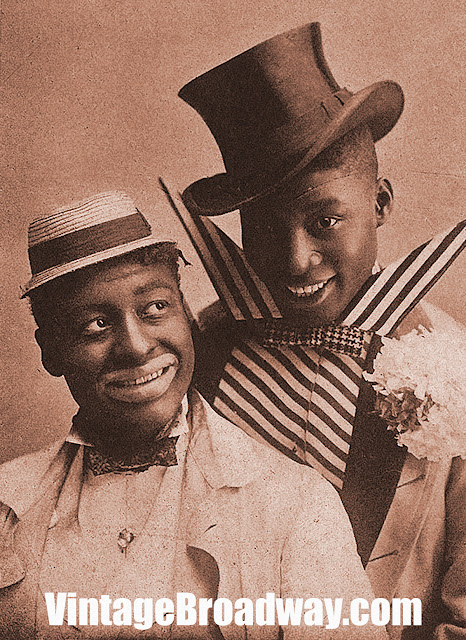
Russell's casting ideas are phenomenal. Bert Williams [1874-1922] and George Walker [1872 or 1873-1911] had both achieved stardom independently before joining forces and debuting in vaudeville at Koster and Bial's in 1897. The duo first appeared on Broadway at the Casino Theatre in 1898 in their act The Gold Bug.

Bert Williams and George Walker.

George Walker was married to Ada Overton Walker, whom Russell had so appropriately cast as Tryxie Tryfle. Known as "The Queen of the Cakewalk," she was also an actress, singer, dancer, and choreographer. If given the chance, she would have owned "Sammy."

Performer Sam Lucas (1848-1916)

Russell provided two casting ideas for Sir Wiley Gyle, whom Russell calls the "long-bearded old man," Sam Lucas and Jesse Sharp. Sam Lucas (1848-1916) began his career in minstrelsy, but became a respected dramatic actor and sometimes composer. I find no information on Jesse Sharp. 

I can find no information on Fred Douglass, whom Russell suggested take the title role of the Wizard. I wish Russell had given us his imaginary cast for the remainder of the principals. 

Alas, this proposed "colored company" of The Wizard of Oz never happened. Or did it? You'll have to wait for part two of this post to find out!

Click here to read PART TWO of The BLACK Wizard of Oz

Copyright © 2022 by David Maxine. All rights reserved.

Thursday, February 3, 2022

Imogene's Lavender Farm

Edwin Stone as Imogene
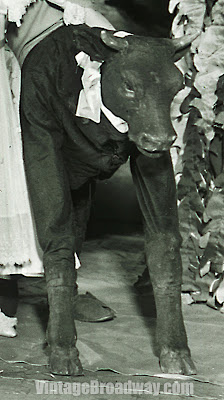
In late July 1903, Joseph Schrode, who had been playing the part of Imogene, the little heifer belonging to Dorothy Gale, became ill and the part of the frolicsome bovine went to a twenty-one-year-old named Luther J. Wyckoff, whose first performance as Imogene seems to have been July 27, 1903. This re-branding of the little heifer generated a fair amount of publicity. 

The August 8, 1903, Dramatic Mirror reported: "Luther Wyckoff, recently with the Winter Circus in Berlin, is now impersonating Imogene, the pet cow of Little Dorothy in The Wizard of Oz. His predecessor, Joseph Schrode, was obliged to resign because of pulmonary trouble and is now resting at Lakewood."

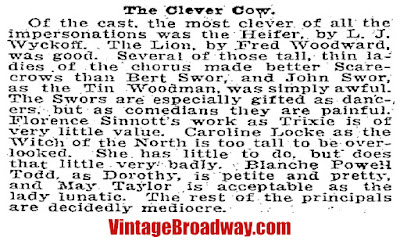
The August 16, 1903, Quad-City Times reported: "They have a new cow in The Wizard of Oz, at the Majestic Theater. The role is apparently an arduous one. Edwin J. Stone had it first, but he had to take a rest. Then came Joseph Schrode, and he too, succumbed. Now Luther Wyckoff, a young German acrobat, is trying it."

Wyckoff had recently been hired to play Imogene in the second touring company, which was scheduled to go out at the beginning of September. So, when Schrode became ill, it afforded Wyckoff a chance to get some Broadway stage experience in the role. Joseph Schrode recovered and took over the role once again in late August; and Wyckoff was in great shape to head out on tour with the second company, which gave its first performance on September 7, 1903. 

The day after the first performance, the Brooklyn Times reported: "L. J. Wyckoff, as Imogene, and C. Ray Wallace, as the Cowardly Lion, are more real than any real calf or lion, and though hidden in feature from the public gaze, probably had ears and peek holes to take in the applause they honestly earned."

Wyckoff's cow was often singled out as the best part of company No. 2's cast:

Seattle Daily Times, October 17, 1904

Luther J. Wyckoff played Dorothy's frolicsome bovine for two seasons with company No. 2—from September 7, 1903, through May 6, 1905.

Luther James Wyckoff was born December 8, 1881, in Galesburg, Illinois. Wyckoff's stage career seems to have been short-lived. I have found no other evidence of a theatrical career save the reference above to his having just been with the Winter Circus in Berlin. This reference probably accounts for the other paper calling him "a young German acrobat." Wyckoff may have been of German descent, but he was an American; his father (a minister) was born in Ohio and his mother was born in Kentucky.

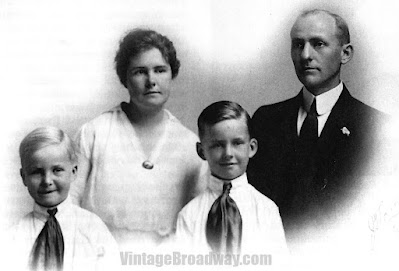
By 1906, Luther J. Wyckoff was living in Seattle and working as a salesman and businessman. He soon married June Lee McKay and in 1909 the couple had two sons, Luther James Wyckoff, Jr. and John McKay Wyckoff.

L. J. Wyckoff and family (circa 1916) Courtesy of Emmy Fairfield.

But in the summer of 1926, Luther J. Wyckoff suddenly became interested in growing lavender—an interest that would sustain him for the rest of his life. 

“Talking of the possibilities of small scale commercial flower growing, brought to mind the Lavender plants which grew so well in our gardens and the use of dried blossoms, long a standard practice. In suggesting this feature as an interesting side-line, I made a casual remark as to thinking that there was an oil produced from this flower as well. Having aroused my own curiosity and a subconscious pioneering instinct by this remark, a visit to the library soon opened my eyes to the wide range of essential oils and gave me a mass of information as to the Lavender plant and its uses.”

Wyckoff's interest bloomed into a life's work. He was instrumental in developing the commercial growing of lavender in the United States, and in particular in the Pacific Northwest—his final lavender farm was in Lacey, Washington. He developed several lavender hybrids that are still popular today.

You can learn much more about Luther J. Wyckoff and his love of lavender in a wonderful essay by Mary Paynton Schaff published in the April 2021 issue of the Thurston County Historical Journal. Click here to read it online. Ms. Schaff will be presenting an online lecture about Luther J. Wyckoff on February 9, 2022, at the Lacey Museum and Cultural Center. To watch it on Zoom you must register here.

I hope you'll join Ms. Schaff for an exploration of Imogene's lavender farm!

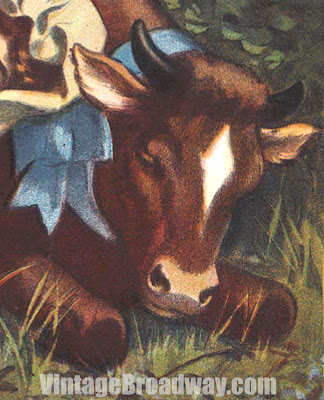
Imogene from a full-color poster for the show.

Copyright © 2022 by David Maxine. All rights reserved.

Tuesday, January 11, 2022

Anatomy of a Forgery

NYPL poster - click to enlarge.

[An earlier version of this post was published July 9, 2019, on Hungry Tiger Talk under the title:

Back in 2018 I was offered what was believed to be an original poster from the 1903 Broadway Wizard of Oz musical (see photo below). The provenance seemed ideal, the poster having been purchased by the current owner from Brenda Baum, widow of L. Frank Baum's third son, Harry Neal Baum. The Baums had run a Wizard of Oz Lodge named Ozcot, which hosted the earliest Oz club conventions. 

From the seller's description, I thought it was going to be another example of a well-known Wizard of Oz poster at the New York Public Library (seen at left). Indeed, I've had a black-and-white photocopy of the NYPL poster for over twenty years, which used to hang in my studio in San Diego. Curiously, the poster I'd been offered was mounted to a piece of green-painted plywood with a wooden frame around it. Hmm...

The original NYPL poster is oddly proportioned - approximately a foot wide and about four feet long. The NYPL poster appears in a number of scholarly publications, including Mark Evan Swartz's Oz Before the Rainbow (2000) and Allan Eyles's The World of Oz (1985). 

The NYPL poster features line art printed in green on white paper. A little more color was added by printing two boxes of type in red and adding red fields of color behind the portraits of the Scarecrow, Tin Woodman, and Dorothy at the top. The words "WIZARD OF OZ" are printed in overlapping green and red, resulting in a rather unattractive brown color. The poster dates from a specific time: directly under the words "WIZARD OF OZ" it says "Now in its 23d Week of Phenomenal Success."

Although the poster I was recently offered (see image below) is identical in size to the NYPL poster, it has several differences. The first is that it was printed in black and white, not green and white with red enhancements. Well, I reasoned . . . maybe the show's producers decided to reprint this poster more cheaply as the show progressed in its run after "its 23d Week of Phenomenal Success."


The Poster I was offered for purchase.

I asked the owner of the poster (friend and longtime Oz Club member) Mark Frederic Dereng for a more detailed photo and on receipt found a most curious thing. The black-and-white poster had exactly
 the same date as the green-and-white NYPL original: "Now in its 23d Week . . ."

Detail of the poster that was offered for sale. Courtesy of owner Mark Frederic Dereng.

Why? Why on earth would the producers have produced a green, red, and white version AND a black-and-white version for the same week of advertising?  I noticed that there was another significant difference between the two posters. The NYPL version has the names of the characters printed in a typeface similar to "Courier."  It looks a lot like a typewriter font. It's actually rather ugly and the lettering is crooked in places and detrimental to the look of the NYPL poster. The offered black-and-white poster had the character names hand-lettered as white text against a black background.

Character Lettering from original NYPL Poster.
Character Lettering from black-and-white version.

The ABC version
On the one hand, the white-on-black lettering seems an improvement of the boring and ugly typeface of the NYPL poster. On the other hand, the new lettering got me kind of worried, as it really looked a lot like the lettering of latter-day Oz book illustrator Dick Martin (1927—1990). The lettering is also forced in places - such as the crude way the black wraps around Sir Dashemoff's foot (see above graphic). 
Hmmm . . .

The quirks of this poster set-off some alarm bells in my head. Yet, the poster supposedly belonged to Baum's son — a solid vintage provenance, it would seem. Could that be confirmed? I asked friends who had attended the old OzCot conventions in the 1960s if they recalled the poster being at Harry Baum's OzCot lodge. One long-time friend quickly replied: he had first seen the poster reproduced in the December 1962 issue of American Book Collector and then on exhibit at OzCot in 1963. He attached high-res scans of the poster from the magazine. (The American Book Collector version of the poster can be seen at right - click to enlarge.) They matched the poster I had been offered. The poster's provenance as belonging to Harry Baum was now verified.

I received several additional phone camera photos of the poster I had been offered. In every way the photos match the American Book Collector version of the poster.

But that black-on-white lettering looked so much like 1960s Oz illustrator Dick Martin's work! And Martin had helped procure the graphics for the 1962 American Book Collector. Had he possibly modified the poster for reproduction in the American Book Collector and then, perhaps, given his photostat to Harry Baum to adorn the Ozcot Lodge? My friend had verified that the poster was at Ozcot by June 1963 — but had Harry Baum owned the poster for sixty years or six months?

As I mentioned up above, once that lettering started shouting Dick Martin, the entire history of the poster became suspect to me. You see, Oz illustrator Dick Martin often tweaked, altered (and sometimes completely invented) graphics back in the late 1950s and '60s, sometimes to make them reproduce more easily, but more troublesome, he occasionally faked vintage research in scholarly publications he worked on.

Below is an early example of a fake 1903 Wizard of Oz poster Dick Martin "invented" for publication and printed in The Musical Fantasies of L. Frank Baum (1958). The Tin Woodman and Scarecrow drawings are Dick Martin trying to look like W. W. Denslow. The poster is based on nothing I have ever found in my very in-depth research into the show.

Dick Martin's "faked" WIZARD poster from MUSICAL FANTASIES OF L. FRANK BAUM.

Dick Martin sloppily photo-statted the faces of Montgomery and Stone from the cover of their Chin-Chin sheet music, circa 1914, nearly a decade after they had quit performing in The Wizard of Oz

Sheet Music from CHIN-CHIN (1914).

Let's look at Dick Martin's lettering on his 1958 "faked" poster:

Dick Martin lettering circa 1958.
It is very similar to the white on black lettering of the large poster I was offered. Using individual letters from Dick Martin's invented poster from Musical Fantasies, I pieced together most of a name to use for comparison. I chose General Riskitt as an example, as he has more letters in common than the other names:

Dick Martin lettering at top, forged poster lettering at bottom.

In my opinion, the clear similarity in lettering style clinched it. The black-and-white version of the poster I was offered seems to have been heavily modified by Dick Martin. It is, in my opinion, a modified photostat of the NYPL original, which, you'll recall, was printed in green and red and celebrates the 23rd week of the run. Here's what I suspect Dick Martin did and some of the reasons why.

Dick Martin certainly knew how important the 1903 show was to the history of Oz and its impact on Baum's life and career. Including a poster from the show in the ABC article would have been a great idea. I suspect Martin chose this poster as it was line art, not one of the more lovely full-color lithograph Wizard posters, and thus would reproduce well in the black-and-white magazine. So Martin obtained a photostat of the poster from the NYPL. A stat would have reproduced the line art beautifully - but there was a catch. Red ink reproduced as black in many photo-statting techniques and indeed still does on many photocopiers. My physical copy of the NYPL poster (the one that used to hang in my studio) was made by taking the poster to the NYPL copystand and simply making a few photocopies. The red ink printed as totally black, obscuring the drawings of the Tin Woodman, Dorothy, and the Scarecrow. Note, too, in the image below, the sort of ugly original Courier typeface of the names "Imogene, the Cow" and "The Cowardly Lion." Why do I point out the ugly Courier type? Because I think the typed names are what Dick Martin found to be so ugly - on an otherwise handsome and reproducible poster - that he felt he ought to "improve" the lettering for the reproduction in the American Book Collector.

Photocopy of poster at NYPL showing how the red ink copies as black.
You can see the red ink reproducing as black is a legitimate problem. To get around this, Dick probably traced the obscured sections from the original, then cut out the black rectangles and redrew the three character faces. As you can see below, Martin's redrawn versions are much cruder than those on the original NYPL poster. He has also added the names of the performers in his distinctive lettering style.

NYPL original on left, redrawn version on right. Click to enlarge.

NYPL original on left, redrawn version at right. Click to enlage.

Note especially the bottom of the picture of Dorothy. Dick Martin has only left the part of the vegetation that is not overlapping the red because that part of the vegetation was obscured in the photostat and he'd apparently not traced it in such detail as to preserve the entire image.

NYPL original on left, redrawn version on right. Click to enlarge.

Here's another example: the title THE WIZARD OF OZ was printed in both red and green - producing a rather ugly brown. But the original NYPL poster is not in perfect registration and the title lettering is quite unattractive. But in a photostat of the NYPL poster, both red and green will reproduce as black, so the text of THE WIZARD OF OZ is thicker and blobbier. You can see below that the Martin version of the poster for American Book Collector is reproduced directly from the NYPL version of the poster, as the shape of his lettering matches the shapes of the combined red AND green inks. I have digitally prepared a version of the word OF showing only the green ink. If the offered poster had been printed in 1903, the printer could have simply used the green printing plate with black ink and gotten a crisp, accurate reproduction of the original typography.

Comparison of the word "OF" - NYPL version, Martin version, then NYPL green ink only.

If the show's producers had wanted to do a black and white version of the poster in addition to the green, red, and white version, all they really had to do was use black ink on the green printing plate (and move the red text block over to the new plate). There is ZERO reason to redraw the sections backed by the red, unless you're working from a black and white photostat of the green and red poster. It is the incredibly time-consuming workaround to achieve a clean drawing that most proves the poster a 1960s era creation by Dick Martin.

So, in my opinion, that's it - Dick Martin modified the stat of the poster he made from the NYPL copy, fancied up the lettering of the character's names, and after he was finished with his modified artwork, he presented it to Harry Baum as a decoration for Ozcot Lodge. Then Brenda Baum sold the poster to my friend who innocently believed he was buying an original 1903 Wizard of Oz poster.

I passed on purchasing the poster.

Sadly, Dick Martin's cleverness and creativity have misled many people and often resulted in some extreme and embarrassing disappointments over the years. Dick Martin faked John R. Neill art, which he presented as gifts to friends on several occasions; he transformed 1940s era dust jackets into very rare first edition dustjackets; and he "invented" vintage advertising posters. One fake poster for Baum's 1906 fantasy John Dough and the Cherub was reprinted in the modern Dover Books edition of that title and presented as genuine period advertising. Martin did not try to profit from his fakes, he made them for fun, as gifts to friends, sometimes perhaps simply to see if he could succeed in his unethical and unscholarly fun. Alas, with some of his "creations," ascertaining whether they are real, partly real, or wholly invented can be very difficult.

But to end this on a more positive note, I'd like to explore a bit more history in how the original poster came to be. The source of the artwork for the original 1903 poster is a drawing printed in the February 2, 1903, New York Evening Telegram.

Original version of artwork in February 2, 1903, New York Evening Telegram.

This artwork was drawn by Henry C. Coultaus (1862-1923), a cartoonist for the New York Evening Telegram, who specialized in drawing illustrations for that paper's Drama section.

Cartoonist Henry C. Coultaus (1862-1923),

Coultaus's Wizard of Oz illustration is for the paper's "What the Playhouses Offer" listing. Note that this original version of the artwork is different than all other versions. The names of the actors appear under the character drawings - not the names of the characters themselves.

Quite probably, the Wizard of Oz's producers were taken with the newspaper artwork and asked to turn it into an inexpensive poster. But those actors names! Some of them were not even with the show anymore by the 23rd week when the poster is first known to have appeared. And besides, the cast changed frequently enough that there would be little accuracy or even point in saying who played whom. So the producers modified the original design - probably having gotten a photostat from the Evening Telegram, and (perhaps in a rush) they painted out the actor names and simply "typed" the character names onto the Evening Telegram's photostat.

This is interesting, I hope, and not too confusing: the newspaper version is about HALF the size of the poster as it was eventually printed. If the "typing" to replace the actors' names with character names was done on the paper's photostat by an actual typewriter, it would explain why the Courier lettering of the poster looks so much like it was done with a typewriter - it was! At first, I'd assumed it couldn't be, because the font was too large to have come from an actual typewriter - but blowing up the newspaper-sized stat (with normal typing on it) would result in the oversize Courier font found on the poster.

I really do wish the offered poster had been genuine. Owning an original poster from the show is still a dream of mine. And you know, a large 58-year-old photostat, mounted on green plywood, created by an official Oz illustrator, and from the personal collection of Harry Baum isn't a bad thing! But it's not the hundred-and-eighteen-year-old poster I had so very much wanted it to be.

UPDATE: Early in 2021 I was able to obtain a genuine poster from the show and from its original run at the Majestic Theater. You can read all about that poster by clicking here.

Copyright © 2022 David Maxine. All rights reserved. 
Thursday, January 6, 2022

Escape from New York

Mott Avenue Station - December 12, 1903
During the original Broadway run of The Wizard of Oz in 1903, much of New York City had literally ruptured with progress. 

The new subway system chiseled streets into chasms, the new and improved water, gas, and electrical infrastructure riddled the city with trenches and holes, and all of that was topped-off with a building boom. 

The New York Sun of September 13, 1903, reported: "Miles upon miles of pavements torn up to repair gas and water mains, lay cables and install power . . . New Yorkers are getting used to the chaos in the streets. They now take it as the natural order of things. They scale peaks and mountain ranges of litter, climb around isolated upheavals of earth and building materials, leap over yawning chasms and look out over scoriated wastes in an absentminded way. . . . on July 1 there were more than twenty-five miles of trenches open."  

Getting a ticket to The Wizard of Oz, then playing at the Majestic Theater just southwest of Central Park, must have provided a delightful escape from the noisy, smelly, and dangerous mayhem.

A curious image of New York City in 1903 recently surfaced, featuring an easily missed Wizard of Oz connection. Can you spot it? Click the image below to begin your hunt.

Longacre Square (soon to be Times Square)  August, 1903 CLICK TO ENLARGE

1 Times Square (viewed from 47th Street)
The image above, dating from August 1903, taken with a wide-angle lens which created a curve of sorts, warps our view as we look north across 42nd Street into the intersection then known as Longacre Square. Seventh Avenue on the left side of the hole, angles toward center, mirroring Broadway, angling toward center on the right side of the hole. 

The gaping chasm is the former foundation of the Pabst Hotel, recently demolished, and will soon become the site of the Times Building (see image at right), a new home for The New York Times. Shortly after the Times moved into the building in January 1905, Longacre Sqaure received its new name: Times Square. 

So, did you spot the Wizard of Oz connection? At the extreme right-hand side of the image, one can just make out a large billboard-sized poster advertising The Wizard of Oz. You can see another large sign advertising Juicy Fruit Gum just beneath it.


In another well-known photograph, this same poster was slathered over the entire side of a building.

A wall of Wizard of Oz posters at Fifth Avenue and 36th Street.
The Portland Oregonian of August 2, 1903, reported that "James M. Rhodes, advertising agent of the new Majestic Theater . . . recently accomplished a unique feat of billposting by covering the immense wall fronting Fifth Avenue at Thirty-sixth street with stands of The Wizard of Oz. No less than 315 sheets of paper were posted on the wall, the stands being 31 sheets long and 15 sheets high." The article stated it was one of the largest stands ever posted in New York. In gratitude, the manager of the Majestic Theater, John S. Flaherty, presented the advertising agent with "a handsome gold-headed cane."

Alas, no copy of this wonderful poster is known to survive, quite probably because it was a multi-sheet image. I've begun a small project to restore the poster using high-res scans of the photograph, above, to be included in my book when completed. Below is one of the better images of the poster.

The Wizard of Oz tornado poster circa summer 1903 CLICK TO ENLARGE
This imagery of this poster is very intriguing, featuring Dorothy (at far left), the Scarecrow and Tin Woodman, along with the Cowardly Lion and Imogene, the frolicsome heifer, being blown about by the Tornado. Imogene is a bit hard to see, her head visible directly below the downstroke of the W in WIZARD. Pastoria's circus hat floats along under the O in OZ. 

But the most unusual thing about the poster is an additional mystery animal peering out between the I and the Z in WIZARD. It appears to be a dog, given the whiskers, canine teeth, and what looks like a dog collar with a chain stretching across the Z in WIZARD. 

There is no other evidence for a dog being in the show this early in the run. Did the poster artist know Baum's book and want to add Toto? Might there have been a "flying dog" image in the cyclone projections? Or a chained-up dog in the Kansas scene? Oddly, Imogene seems crammed into the composition. The poster would have been better had Imogene been placed where the mystery dog appears, thus leaving some empty space under the W and between the Cowardly Lion and the Scarecrow and Tin Woodman.

Another dog-gone mystery! 

Copyright © 2022 by David Maxine. All rights reserved.